Assisted stretching in Blue Springs is one on one flexibility work where a coach moves you into each stretch, adds resistance, and guides you to relax deeper than you can on your own. At CrossFit Cerberus that means PNF stretching, plus body tempering where your muscles need deeper pressure. Regular sessions, plus a little work at home, help you build more usable range and keep it.
This guide covers what assisted stretching is, how PNF stretching works, what a session looks like at our gym in historic downtown Blue Springs, how often to go, and how it compares with massage and stretching at home. It is written for lifters, kettlebell athletes, CrossFit members, and adults from Blue Springs, Grain Valley, Lee's Summit, and Independence who feel tight from sitting, work, or getting older.
What Assisted Stretching Is
In a normal stretch, you are doing two jobs at once. You hold the position, and you try to relax the muscle you are stretching. Most people end up tensing something to stay in place, so the stretch stops short.
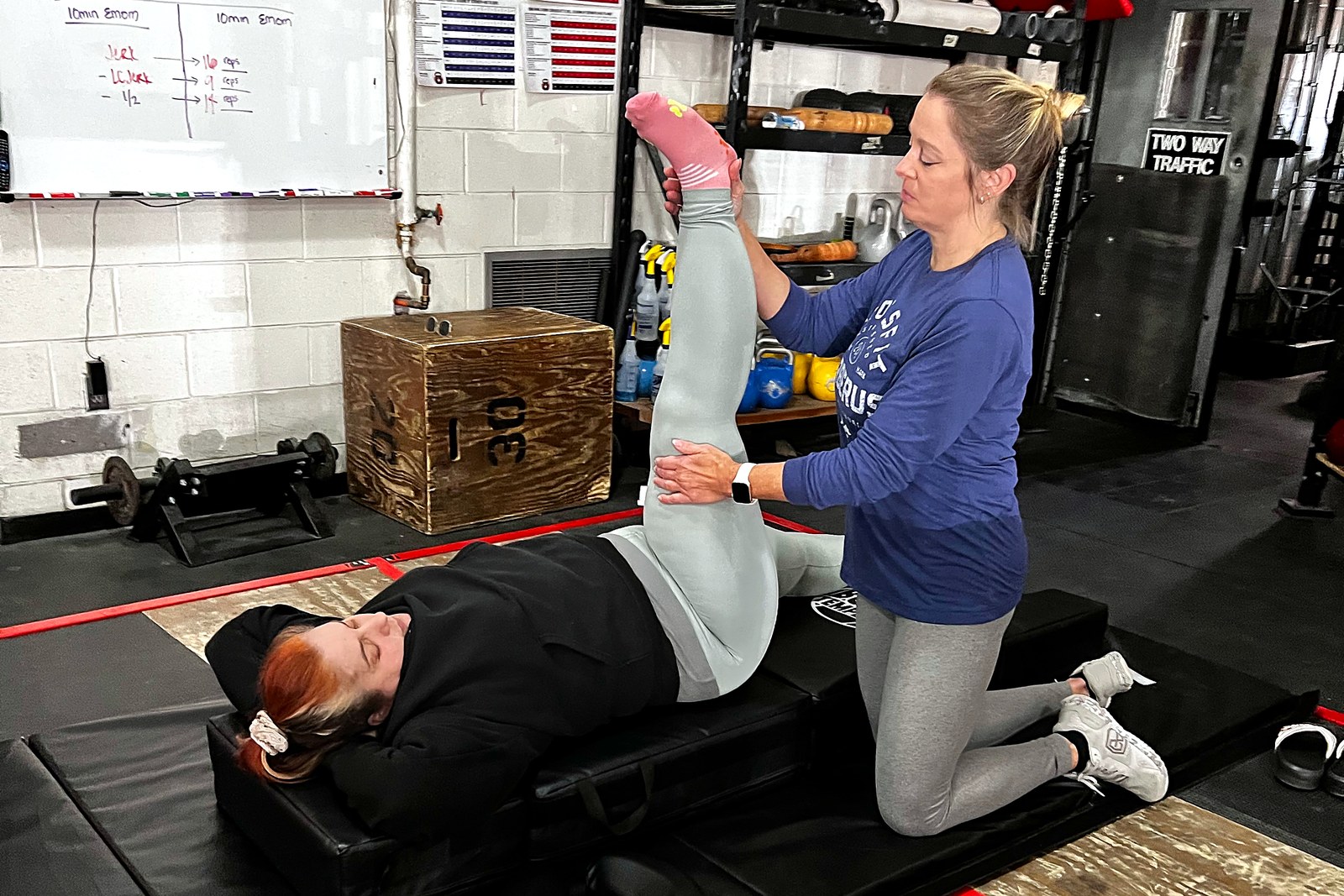
Assisted stretching splits those jobs. You lie on a table or mat. The coach holds your leg or arm, places the joint, and controls how far it goes. Your only job is to breathe, follow a few short cues, and tell the coach what you feel. Because nothing has to brace, the muscle can let go further.
A good assisted stretching session is not a coach pushing as hard as possible. It is a conversation. The coach watches where the range stops, asks what you feel and where, and adjusts the angle so the stretch lands in the right muscle instead of pinching a joint.
How PNF Stretching Works
PNF stands for proprioceptive neuromuscular facilitation. The name is long, but the method is simple. The most common version is called contract relax:
- Stretch: the coach takes the muscle to a comfortable end range.
- Contract: you push against the coach's hand for a few seconds without the joint moving.
- Relax: you breathe out and let the muscle go.
- Go further: the coach eases you into the new range, then repeats the cycle two or three times.
A review in the International Journal of Sports Physical Therapy describes PNF contractions held for about 10 seconds before relaxing, with resistance from a partner or a strap. A separate review of PNF research found that PNF improves range of motion, and that it works best after training or on its own, not right before a maximal lift, because it can reduce performance in max effort work for a short time afterward.
That is the reason we usually schedule assisted stretching after training or on a rest day, not five minutes before a heavy squat or a kettlebell set.
What an Assisted Stretching Session Looks Like at CrossFit Cerberus
Our recovery coaches, Candace and Brook, run every session one on one. Here is the flow.
Your first visit
Your first visit is a free 30 minute Flexibility and Recovery Assessment. A coach checks your mobility and the common areas of restriction, like the hips, hamstrings, upper back, and shoulders. Then you try body tempering and PNF stretching on the spots that need it, so you know how each one feels before you commit to anything. You leave with a recommended plan.
Ongoing sessions
Ongoing sessions are one on one, 30 or 50 minutes, booked in blocks. We go over options at your assessment. A typical session moves through a quick check of how you feel and what you trained that week, PNF stretching on the main areas, and body tempering where a muscle needs deep, even pressure. Your coach may also give you a few stretches to do at home between visits.
What it should feel like
Firm pressure and a strong stretch, not pain. If you catch yourself holding your breath or clenching, tell your coach. We change the angle, the pressure, or the roller. If you want to know more about the weighted roller, read what body tempering is and how it works.
When to check with your doctor first
Assisted stretching is for tight, healthy tissue. It is not treatment for an injury, and we do not diagnose pain. If you have a recent injury or surgery, bring what your doctor or physical therapist has cleared you to do, and we work inside that. If something feels sharp, numb, or wrong during a session, say so right away and we stop or change the stretch.
Who Assisted Stretching Helps Most
Assisted stretching fits people who train hard and people who barely train at all. The common thread is feeling stiff and wanting to move better.
- Lifters: tight hips and ankles limit squat depth, and a stiff upper back makes overhead pressing harder. More usable range lets you hold better positions under load.
- Kettlebell sport athletes: long sets put steady demand on the hips, upper back, and shoulders. Recovery work between hard sessions helps you show up to the next one moving well. See our Kettlebell Sport program.
- CrossFit members: mixed training hits every joint. Assisted stretching gives the areas that stay tight focused time that a class warm up cannot.
- Desk workers and drivers: hours in a chair keep the hip flexors short and the shoulders rolled forward.
- Adults who feel tighter every year: range of motion tends to shrink when it is not used. A coach can find where you are losing it and help you get it back safely.
Flexibility on a table is only half of it. You also need strength and control in that range. Our post on mobility vs flexibility explains why, and how to test both.
How Often Should You Get Assisted Stretching?
It depends on how tight you are and how hard you train. The PNF review above found range of motion gains from consistent PNF stretching done at least twice a week, and noted that gains need regular work to hold. In practice, that usually looks like this:
- Getting started: sessions closer together while you build range, paired with the home stretches your coach gives you.
- Training hard: a regular session after heavy weeks or before a competition block, so recovery keeps pace with training.
- Maintaining: fewer sessions once you are moving the way you want, with home stretching between visits.
Your coach recommends a schedule at your assessment based on what we find, not a one size fits all package.
Assisted Stretching vs Massage vs Stretching on Your Own
All three can help you feel looser. They do different jobs.
- Stretching on your own costs nothing and you can do it daily. The limits are bracing to hold positions, guessing at angles, and skipping the areas you cannot reach well.
- Massage works mostly on soft tissue with hands and pressure while you stay passive. It does not usually take joints to end range or use contract relax cycles.
- Assisted stretching combines a coach who controls the position with your own muscle contractions, so you gain range you cannot reach alone. At CrossFit Cerberus it is paired with body tempering for deep pressure, so one session covers both.
You can use all three together: assisted stretching and body tempering in the gym, a short routine at home, and the training that puts the new range to work.
Assisted Stretching FAQ
Is assisted stretching worth it?
Assisted stretching is worth it if you feel tight, stall on positions in training, or never stick with stretching on your own. A coach controls the angle and uses PNF contract relax cycles, so you reach range you cannot get alone. It works best when you also stretch at home and use the new range in your training, so the gains last between sessions.
How often should you get assisted stretching?
Research on PNF stretching found range of motion gains with consistent sessions at least twice a week, and gains fade without regular work. Most people start with sessions closer together, then space them out once they move better, adding home stretching between visits. At CrossFit Cerberus your coach recommends a schedule at your free Flexibility and Recovery Assessment.
What is the difference between assisted stretching and massage?
Massage applies pressure to soft tissue while you stay passive. Assisted stretching moves your joints toward end range while you contract and relax the muscle against the coach's resistance, which is how PNF stretching builds range. Some sessions combine both ideas. At CrossFit Cerberus we pair PNF stretching with body tempering, a weighted steel roller that gives deep, even pressure.
Does assisted stretching hurt?
Assisted stretching should feel like a strong stretch and firm pressure, not pain. If you hold your breath, clench, or feel anything sharp, the stretch is too much, and a good coach adjusts right away. Speak up during the session. Your coach changes the angle, the pressure, or the roller weight so the work stays productive and comfortable enough to relax into.
What should I wear to an assisted stretching session?
Wear clothes you can move and lie down in, like athletic shorts or joggers, leggings, and a T shirt. Avoid jeans, belts, and stiff fabrics that limit how far your hips and knees can bend. Comfortable clothing lets the coach place your joints correctly, and it makes it easier to relax on the table during PNF stretching and body tempering.
CrossFit Cerberus is at 200 NW 11th St in historic downtown Blue Springs, an easy drive from Grain Valley, Lee's Summit, and Independence. Questions? Call (816) 441-4426.
Start with a free 30 minute Flexibility and Recovery Assessment on our Stretching and Recovery page, and see how assisted stretching and body tempering feel on your own body.