
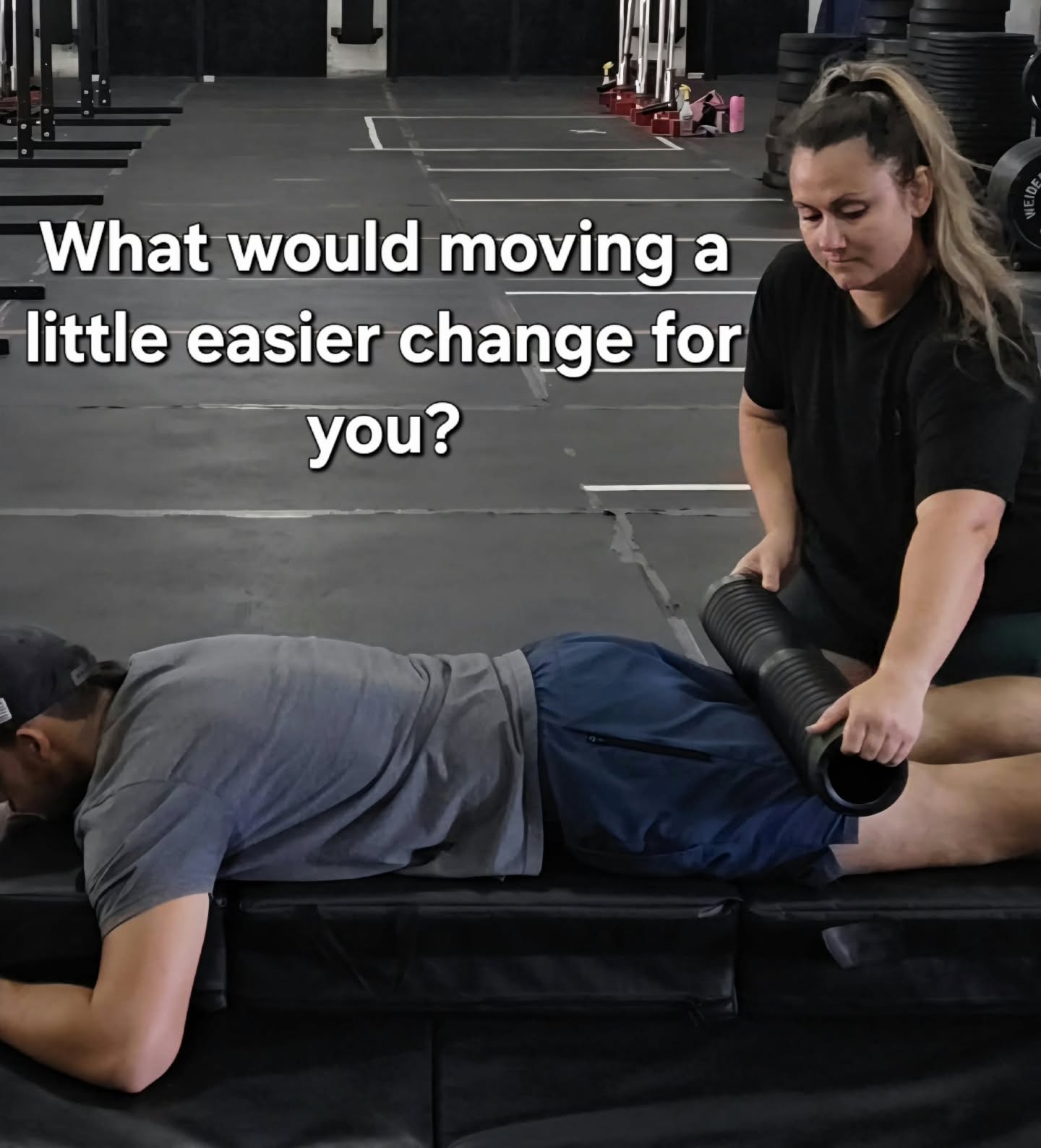
Body tempering is a recovery method where a coach rolls a weighted steel cylinder, usually 20 to 100 pounds or more, slowly across your muscles while you lie still and relax. The weight of the roller does the work, so you get deep, even pressure without bracing against it the way you do on a foam roller. At CrossFit Cerberus we use body tempering in Blue Springs for lifters, kettlebell sport athletes, CrossFit members, and adults who feel stiff from sitting all day.
What Body Tempering Is and Where It Came From
Body tempering was developed in 2014 by powerlifter Donnie Thompson for the lifters in his gym. The tools are solid cylinders made of steel, cast iron, or loaded plastic. Common commercial rollers are 24 inches long, with a 50 pound version about 4.5 inches across and an 80 pound version about 5 inches across. Some can be loaded past 200 pounds for large athletes.
Physical therapist Zach Long describes it in his introduction to body tempering as soft tissue mobilization performed by rolling weighted cylinders across muscles and joints. The key difference from most recovery tools is that the person receiving it does nothing. They lie on a table or mat, breathe, and let the muscle go slack.
Why the weight matters
A heavy roller with a long contact surface spreads its load across a wide strip of muscle. That gives a lot of total pressure without a sharp point. On a foam roller or lacrosse ball, you hold yourself up with your arms and legs, which keeps the target muscle partly tense. On a tempering roller, there is nothing to hold, so the muscle can relax under the load.
What a Body Tempering Session Looks Like
A session covers two to four areas, in this order.
- Check first. The coach asks where you are stiff, what you trained this week, and whether anything has changed medically. Then we test a movement tied to that area, for example a deep squat, an overhead reach, or a weight bearing lunge for the ankle.
- Pick the roller. Lighter rollers for smaller people, sensitive areas, and first sessions. Heavier rollers for large muscle groups like the quads, hamstrings, and upper back.
- Place and hold. The roller sits on the muscle for 20 to 30 seconds so the area can settle under the load.
- Roll slowly. The coach moves it along the length of the muscle, about one pass every two seconds, for one to two minutes per area.
- Move right after. We retest the movement and then load it lightly, such as a set of goblet squats or overhead holds, so you use the new range immediately.
The pressure should be strong but tolerable. If you start holding your breath or tensing, the roller is too heavy or the spot is too sensitive, and we adjust.
Body Tempering vs Foam Rolling vs Massage
All three apply pressure to soft tissue. The differences are in who does the work, how the load is spread, and how much control you have.
Foam rolling
You control the pressure with your own bodyweight. It is cheap and you can do it daily at home. The limits are a small contact area, the effort of holding yourself in position, and the difficulty of reaching some areas well.
Massage
A massage therapist uses hands, forearms, and elbows to work specific tissue and can adjust in fine detail. It takes longer and costs more per session. Carl's background in massage and corrective exercise shapes how Cerberus coaches use the roller: pressure follows the muscle, and the session ends with movement.
Body tempering
The roller provides a large, steady load you could not produce on yourself, and you stay fully relaxed. It works best on big muscle groups. It is less precise than hands and needs a coach to run it, so it is a supplement to your own mobility work, not a replacement for it.
What the Research Says About Body Tempering
The research is early. Most of what is written about body tempering comes from coaches and physical therapists describing their clinical experience.
One controlled study, Body Tempering and its Effect on Ankle Dorsiflexion and Power (Ori and colleagues, Clinical Practice in Athletic Training, 2022), compared 30 seconds of body tempering on each calf with 30 seconds of foam rolling in 20 college age adults. Both methods produced a small, statistically significant increase in single leg broad jump distance. Ankle range of motion improved significantly only on one leg with body tempering. When the two methods were compared directly, there was no significant difference in power or range of motion.
What that means in practice: a short bout of pressure on a muscle before training can help it move and produce force a little better, and body tempering does that at least as well as foam rolling. It is not proof that body tempering speeds healing, prevents injury, or fixes any condition, and we do not present it that way.
Who Body Tempering in Blue Springs Is For
We use body tempering most with these groups:
- Lifters and CrossFit athletes with heavy squat, deadlift, and pressing weeks who feel stiff in the hips, quads, and upper back. It fits well on lighter days between CrossFit classes.
- Kettlebell sport athletes who hold the rack position and grip a bell for 10 minute sets. The forearms, upper back, and legs take a lot of repeated load. It suits athletes in kettlebell sport between hard training blocks.
- Desk workers whose hips and upper back stiffen from sitting, and who want to move better before a workout.
- Adults over 40 and 50 who are returning to training and recover more slowly between sessions. If that is you, our post on CrossFit for beginners over 40 in Blue Springs covers how we build training volume gradually.
- People in one on one training who need extra prep for a stiff area before strength work. That pairs well with personal training, where the coach sees how you move every session.
When to check with a doctor first
Body tempering puts a lot of pressure on tissue. Physical therapists who use it list low bone density, skin problems over the area, easy bruising, and low pressure tolerance as reasons it may not fit. If you take blood thinners, had recent surgery, have an unexplained pain, or manage a medical condition, get clearance from your doctor or physical therapist first. Coaches stay off bones, open skin, and areas that are swollen or recently injured.
How to Fit Body Tempering Into a Training Week
Body tempering supports training. It does not replace sleep, enough protein, sensible training volume, and regular mobility work. Here is a simple structure we use:
- Before training: one to two minutes on the stiffest area, then the warm up. Example: quads and hips before a squat day.
- After hard sessions: lighter rolling on the muscles worked, followed by easy movement.
- On a recovery day: a full session on two to four areas, then 10 to 15 minutes of walking or light mobility.
Week to week, the coach tracks the retest movement. If your squat depth or overhead reach holds better from one session to the next, we keep going. If nothing changes after a few sessions, we look at your training load, sleep, and movement patterns instead of adding more rolling.
Body Tempering FAQ
What is body tempering?
Body tempering is soft tissue work done with a heavy steel or cast iron cylinder. The roller rests on a muscle or is moved slowly along it, so its weight supplies steady, broad pressure. It was developed by powerlifter Donnie Thompson for lifters in his gym and is now used by strength athletes, physical therapists, and recovery coaches.
Is body tempering better than foam rolling?
It is different more than better. A foam roller uses your own bodyweight and a small contact area. A tempering roller uses its own weight and a long contact area, so you can relax completely while it works. In one small 2022 study, both methods improved single leg jump distance, with no significant difference between them.
Does body tempering hurt?
It should not. The goal is strong, even pressure that you can breathe through and relax under. Because the roller is long, the load spreads over a wide area, which is why many people find it less sharp than a lacrosse ball or foam roller. If a spot turns sharp or you tense up, the coach lightens the roller or moves off it.
How often should you do body tempering?
There is no research based schedule yet. In practice, short sessions of one to two minutes per area work well before training to prepare a stiff region, or after training and on rest days for recovery. At Cerberus, frequency is set by how you respond and how hard you are training that week, not by a fixed rule.
Who should not do body tempering?
Physical therapists who use it say it is a poor fit for people with low bone density, skin problems over the area, a low tolerance for pressure, or a tendency to bruise easily. Anyone on blood thinners, recovering from surgery, or managing a medical condition should get clearance from a doctor or physical therapist before trying it.
How CrossFit Cerberus Coaches Recovery in Blue Springs
CrossFit Cerberus has coached adults at 200 NW 11th St in Blue Springs since 2012, and we see members from Lee's Summit, Independence, Grain Valley, Oak Grove, and eastern Kansas City. Owner and head coach Carl Neidholdt has coached since 1994, with a gymnastics background that includes coaching the USA Gymnastics World Age Group Team, plus training in massage and corrective exercise. That background is why recovery at Cerberus follows the same rule as everything else we teach: perfect the basics. Check how you move, apply the right amount of pressure, then use the new range under load.
Body tempering sits next to our coached and scaled CrossFit classes, kettlebell sport team, personal training, and Cerberus Nutrition coaching. If you are not sure where to start, a free intro is the place to sort that out.
Book a free intro: https://www.crossfitcerberus.com/programs/get-started


