Mobility vs flexibility in Blue Springs comes up every week at CrossFit Cerberus, usually from someone whose squat stops short or whose hips feel tight after a day at a desk. Flexibility is how far a muscle can be stretched passively. Mobility is how far you can move a joint actively, under your own control. You need flexibility to have the range, and you need strength and control in that range to use it when you lift, run, or pick up a grandkid.
This post covers what each one is, how to test both in about five minutes, how to train each, and how we fit the work into classes for adults in Blue Springs, Lee's Summit, Independence, Grain Valley, and Oak Grove.
Mobility vs flexibility: the definitions
Hinge Health puts it simply: mobility is the ability to actively move a joint through its full range of motion, and flexibility is the ability to passively stretch muscles and tendons. Mobility requires muscle engagement. Flexibility does not.
Flexibility
Flexibility belongs to the soft tissue: muscles, tendons, and fascia. You measure it passively. Lie on your back, loop a strap around one foot, and pull the straight leg toward you. How far it goes is hamstring flexibility. Gravity, a partner, or a strap did the work.
Mobility
Mobility belongs to the joint and the muscles that move it. Lie in the same position, take the strap away, and lift the straight leg as high as you can on your own. That number is hip flexion mobility. It is almost always lower than the strap number. The gap between the two is range you have but cannot yet control.
That gap is the useful number. In my coaching since 1994, starting with gymnasts, the athletes who stayed healthy were not the ones with the biggest passive range. They were the ones who could hold and move through their range with strength.
Why the difference matters when you lift
A barbell does not care how far a muscle can be stretched lying on the floor. It cares where your joints are when the load is on them.
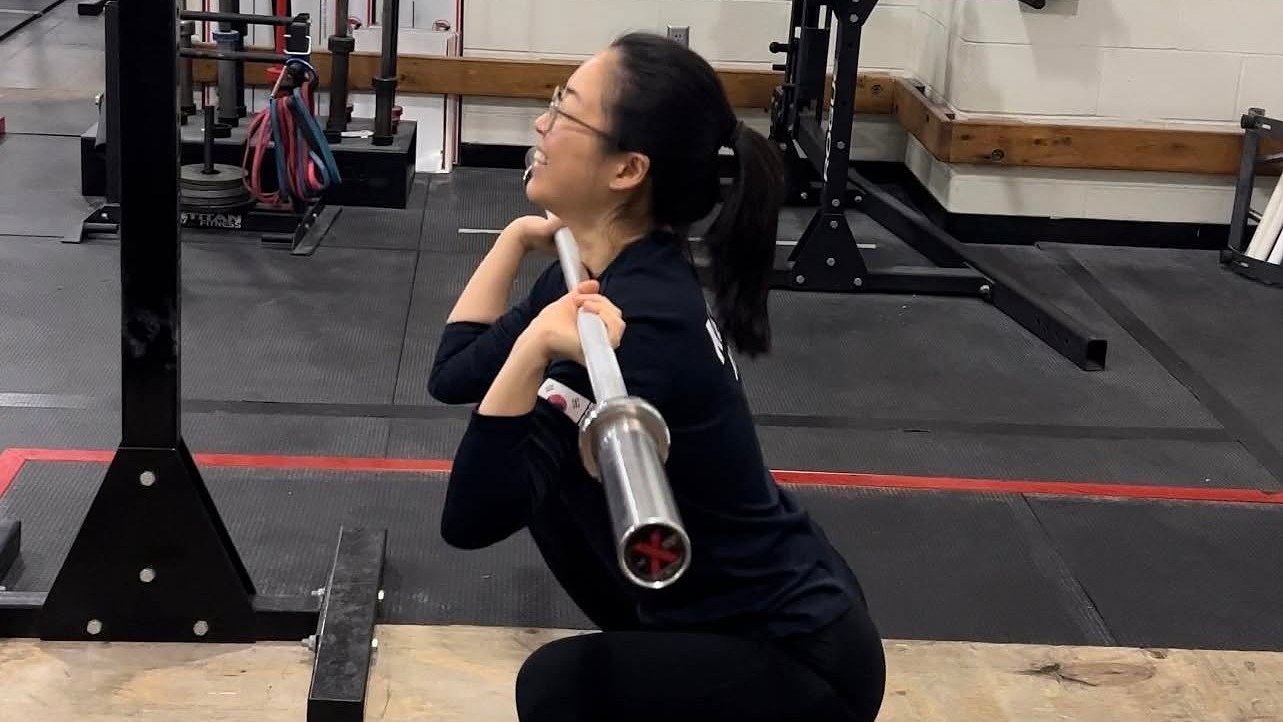
- Squat: depth depends on active hip flexion and ankle dorsiflexion, and on keeping the trunk braced at the bottom. Someone with flexible hamstrings can still lose position at depth if the hips and core cannot hold it. More on that in why you need to squat.
- Overhead press: pressing overhead needs shoulder flexion and upper back extension you can hold while bracing. If the range is not there, the lower back arches to make up for it.
- Deadlift and bent over row: both need hip hinge range with a neutral spine. Hamstring flexibility sets how far you can hinge. Control sets whether the back stays flat at that point.
When range runs out, the body borrows it from the next joint up or down the chain. That compensation is what the coach watches for, and it is why we test before we load.
How to test your mobility and flexibility
These four checks take about five minutes. Do each side and write down what you see. Retest every four weeks.
1. Active vs passive straight leg raise
Lie on your back. Raise one straight leg as high as you can without help, and note the angle. Then use a strap to pull it higher. In my coaching, a gap of more than about 20 degrees usually means flexibility is ahead of control at the hip.
2. Knee to wall ankle test
Face a wall in a half kneeling stance with the front foot a few inches back. Drive the knee toward the wall without the heel lifting. Move the foot back until the knee can just touch. Compare sides. A big side to side difference shows up later as a shifted squat.
3. Bodyweight squat hold
Squat as deep as you can with heels down, chest up, and hold for 30 seconds. If you need to hold a post to get there, that is flexibility you have but mobility you do not yet own.
4. Wall overhead reach
Stand with your back, head, and hips on a wall, low back lightly pressed in. Raise straight arms overhead toward the wall. If the low back peels off the wall before the thumbs touch, the shoulder or upper back range is short.
How to train each one
Flexibility: static stretching
The American College of Sports Medicine guidance recommends flexibility exercise at least two or three days per week. Hold each stretch 10 to 30 seconds to the point of tightness or slight discomfort, and repeat two to four times to reach about 60 seconds per stretch. It works best when the muscle is warm, so stretch after training or after light cardio.
A simple set for lifters: couch stretch for the hip flexors, half kneeling hamstring stretch, doorway pec stretch, and a calf stretch on a plate. Two rounds of 30 seconds per side covers all four in about eight minutes.
Mobility: active, controlled range
Mobility drills are slow and loaded by your own muscles. Examples we use:
- Goblet squat pry: hold a light kettlebell, sit in the bottom of a squat for 30 to 45 seconds, and shift side to side.
- Active leg lowers: 3 sets of 6 per side, lowering one straight leg slowly while the other stays up.
- Controlled shoulder circles: 5 slow circles each direction, as big as possible without the ribs flaring.
- Tempo squats: 3 sets of 5 with a 4 second lower and a 2 second pause at the bottom.
The pattern is the same for every drill: get to the end of the range you can control, then spend time there with tension. As the passive range opens from stretching, these drills turn it into usable range.
Where recovery work fits
Soft tissue work such as foam rolling or body tempering can make a stretch or warm up feel easier. It does not build strength in a range, so we use it before stretching and drills, not instead of them.
Mobility and flexibility after 40, and around old injuries
Range tends to shrink with fewer years of varied movement, long hours sitting, and old injuries that were never rehabbed. The fix is the same as at 25: test, stretch to open the range, and strengthen inside it. Progress is slower, so the timeline is weeks, not days. In my coaching, most people see the active straight leg raise and squat hold change within four to eight weeks of consistent work.
If a joint has been injured, operated on, or hurts with movement, get cleared by a doctor or physical therapist first. Pain during a stretch or drill is a stop sign, not a target. For adults working around pain or limited range, personal training lets a coach build the plan one joint at a time. Beginners and adults 40 and up can also start with the Start Here Workshop, and our Strong and Steady 60+ program builds strength and range for older adults.
FAQ: mobility vs flexibility
What is the difference between mobility and flexibility?
Flexibility is how far a muscle and tendon can be stretched passively, with help from gravity, a partner, or a strap. Mobility is how far you can move a joint under your own muscle control. Flexibility is one part of mobility. The other parts are strength and control at the end of the range, which is why a flexible person can still move poorly.
Is mobility or flexibility more important?
For lifting and daily life, mobility matters more, because every rep and every step is active movement. Flexibility still counts. If the tissue cannot lengthen, there is no range to control. Train flexibility to open the range, then train mobility so you can own that range under load. Most adults need some of both each week.
Can you be flexible but not mobile?
Yes. A common example is someone who can pull a knee to the chest lying down but cannot get the hips that deep in a bodyweight squat. The tissue lengthens, but the muscles that hold the position are not strong or coordinated there yet. Slow, controlled reps at the deepest position you can hold are how that gap closes.
How often should you do mobility and flexibility work?
The American College of Sports Medicine guidance is flexibility work at least two or three days per week, holding each stretch 10 to 30 seconds and repeating it to build about 60 seconds per stretch. Short mobility drills fit into every warm up. In my coaching, ten minutes on most days has worked better than one long session on Sunday.
Is foam rolling mobility or flexibility?
Foam rolling is soft tissue work, so it sits closer to flexibility and recovery than to mobility. It can make a stretch or warm up feel easier, but it does not build strength or control in a range. Use it before stretching or drills, not in place of them. Body tempering, done by a coach with a weighted roller, is in the same category.
How CrossFit Cerberus coaches mobility and flexibility in Blue Springs
Every CrossFit class at Cerberus is coached and scaled, and that includes range of motion. The warm up uses mobility drills matched to the day's lift: ankle and hip work before squats, shoulder and upper back work before presses. The coach checks positions before load goes on the bar and adjusts depth, grip, or stance when range is short. Classes include coach led stretching and flexibility work.
The standard is the same at every level: perfect the basics. Own the range first, then load it. I come from gymnastics, massage, and corrective exercise, and that background shapes how we look at a stiff hip or a shoulder that will not go overhead.
Book a free intro and we will run these tests with you: https://www.crossfitcerberus.com/programs/get-started