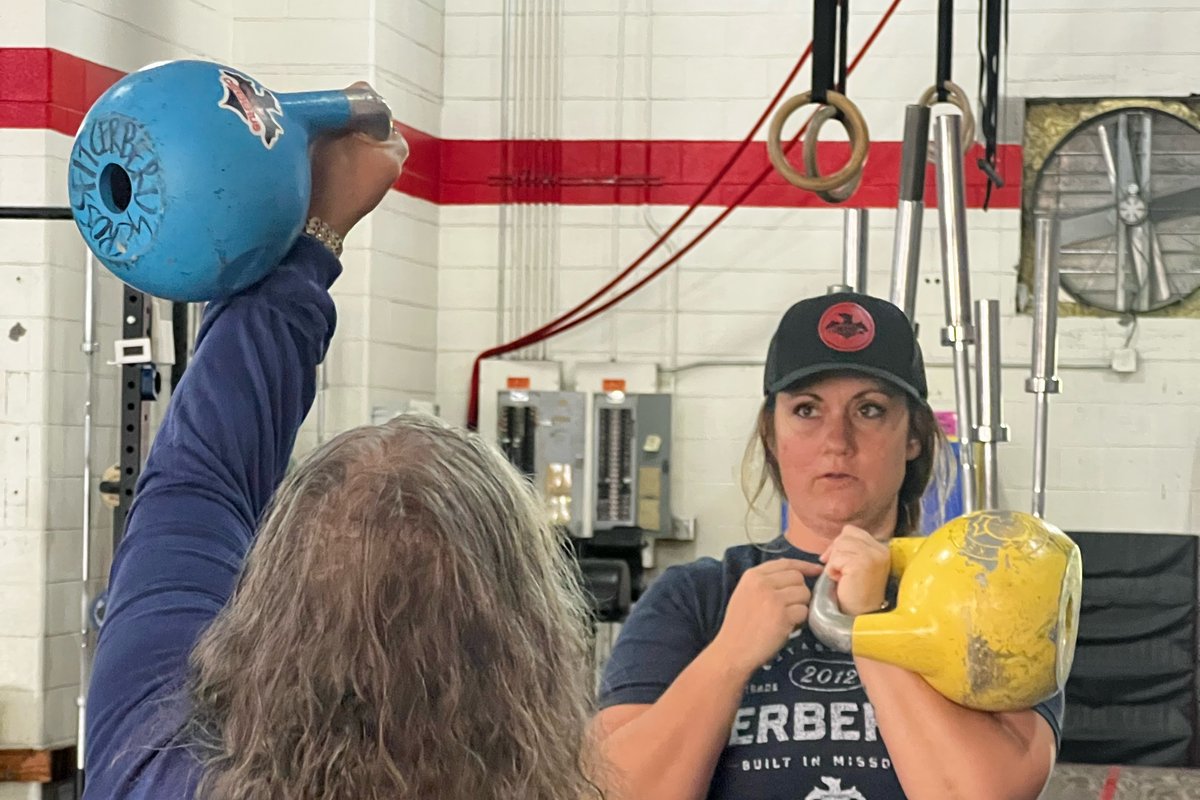
For kettlebell weight for beginners in Blue Springs, the answer is simple: start with a bell you can move for several minutes with clean technique, not the heaviest bell you can lift once. In kettlebell sport that usually means 8 kg or 12 kg for women and 12 kg or 16 kg for men. The bell goes up when your technique holds for the full set, not when the set feels easy for one minute.
Kettlebell sport is judged on reps completed in a timed set, so the right bell is the one that lets you keep moving. A bell that is too heavy ends the set early and builds bad habits in the rack and lockout. A bell that is too light teaches nothing about pacing. This guide covers how to pick a starting bell, what competition rules say about weights, and how a coach decides when you move up.
Why Kettlebell Sport Weight Choice Is Different
In general kettlebell training, you might pick a bell for 10 swings or 8 presses. In kettlebell sport, sets last minutes, not seconds. Competition sets run 10 minutes in traditional formats, and longer events run 30 or 60 minutes. That changes the question from "how much can I lift" to "how much can I lift, rest with, and breathe under for the whole set."
Three things limit a sport set before raw strength does:
- Grip. The snatch and the swing phase of the long cycle load the fingers on every rep.
- The rack. In the jerk and long cycle, the bells rest on your body between reps. If the bell is too heavy to rest in the rack, you are working instead of recovering.
- Breathing. Each rep is matched to breaths. A bell that forces you to hold your breath shortens the set.
A beginner bell lets all three hold up while you learn the timing of each lift.
Kettlebell Weight for Beginners: A Starting Point
Competition rules give a useful reference. In IKSFA rules, amateur adult men lift 12 kg or 16 kg and amateur adult women lift 8 kg, 12 kg, or 16 kg, according to the athlete classification summary at Kettlebell University. IKMF uses 4 kg steps between bells, with a minimum of 16 kg for men and 8 kg for women.
Those numbers are for people who already compete. For your first weeks, Carl's coaching observation is that most people do better starting at the lighter end and earning the next bell:
- Women new to kettlebells: 8 kg for snatch and long cycle practice. Some start the jerk at 8 kg per hand with two bells or 12 kg with one bell.
- Men new to kettlebells: 12 kg for snatch and long cycle practice, 16 kg once the rack and lockout are stable.
- Adults returning from time off, or working around back, knee, or shoulder limits: one size lighter than the above. If you are under care for an injury, get cleared by your doctor or physical therapist first.
Body weight, age, and training history all change the starting bell, which is why the first class includes a coach watching your lifts before a weight is set.
A simple test for your bell
Pick a bell and do 2 minutes of one arm long cycle or snatch at a steady pace, switching hands once. The bell fits if:
- Your rep speed in the second minute matches the first.
- You can breathe in the rack or overhead without holding your breath.
- Your lockout is still straight and still on the last rep.
If any of those break before 2 minutes, go one size down. If all three hold easily for 4 minutes or more, the coach may move you up.
Competition Bells vs Cast Iron Bells
Kettlebell sport uses competition bells. These are steel bells that are the same size regardless of weight. An 8 kg competition bell and a 24 kg competition bell have the same body and handle shape, so the rack position and the path of the bell stay the same as you get stronger. Kettlebell Kings explains that competition handles are also uniform and smaller in diameter than most cast iron handles, which reduces grip fatigue.
Cast iron bells grow larger as they get heavier. That is fine for general training, but it means your rack and hand position shift every time you change bells. For sport practice, a uniform bell lets you learn one position and keep it.
This matters for your choice of weight. A heavy cast iron bell and a light one feel like different tools. Competition bells let you change only one variable, the load.
How Bell Weight Progresses Over Time
Moving up a bell in kettlebell sport is a bigger jump than it looks. Going from 12 kg to 16 kg is a 33 percent increase in load, held for every rep of a multi minute set. That is why progress usually comes in this order:
- Set length. Build from sets of a few minutes toward 10 minutes with the same bell.
- Pace. Raise reps per minute while keeping the set length.
- Fewer hand switches. Work longer on each hand before switching.
- Bell weight. Only after the first three are stable.
At Cerberus, progress in kettlebell sport is tested every 10 weeks. Between tests, the bell stays the same unless the coach sees your technique holding for the full set with room to spare.
What Competition Weights Look Like
If you decide to compete later, the IKMF rules show where the bells end up. According to the IKMF rules summary:
- The IKMF Marathon is a 60 minute continuous set. The Half Marathon is a 30 minute continuous set.
- Women's standard bells are 12 kg for the 60 minute marathon and 16 kg for the 30 minute half marathon.
- Men at Rank 2 and Rank 3 use 16 kg for 60 minutes or 24 kg for 30 minutes. Higher ranks use 24 kg for 60 minutes or 32 kg for 30 minutes.
- Multiple hand switches are allowed in single bell marathon events.
- For amateur and non ranked events, scores are multiplied by a bell coefficient, so a lifter using a lighter bell can still compete fairly.
Those long sets explain why a lighter bell with steady pace often beats a heavier bell lifted in short bursts. The Cerberus kettlebell sport team has produced multiple IKMF world champions and podium finishes, and Carl took bronze representing the US at the 2026 IKMF World Kettlebell Championships. Competing is optional. Most members train kettlebell sport for strength and work capacity without ever entering a meet.
For a breakdown of the three main lifts and how each one uses the bell, read Long Cycle vs Jerk vs Snatch.
Common Mistakes When Picking a Bell
- Picking by ego. A heavy bell for 30 seconds trains a different thing than a moderate bell for 5 minutes.
- Using one bell for every lift. Many lifters jerk a heavier bell than they snatch, because the jerk uses the legs to drive the bell and the snatch puts more load on the grip.
- Moving up after one good day. One strong set is not the same as a stable set week to week.
- Buying bells before learning the lifts. Cerberus provides the bells in class, so you can find your weight before you buy anything for home.
FAQ
What size kettlebell should a beginner use?
For kettlebell sport, most beginner women start at 8 kg and most beginner men start at 12 kg. The right bell lets you move for 2 to 4 minutes with steady pace, a straight lockout, and even breathing. Body weight, training history, and any joint limits change the starting point, so a coach should watch a few sets before you settle on a bell.
Is a 16 kg kettlebell heavy for a beginner?
For a man with some lifting background, 16 kg is a common bell for the jerk and long cycle after a few weeks of practice. For most beginner women, 16 kg is heavy for timed sets and is better saved for later. In IKMF rules, 16 kg is the standard women's bell for the 30 minute half marathon, which shows it is a competitive weight.
Should I use a lighter or heavier kettlebell?
Start lighter. Kettlebell sport rewards reps over a long set, and a lighter bell lets you learn the rack, lockout, and breathing pattern that every heavier bell will need. Move heavier once you can hold good technique for the full set with the current bell. Going heavy too early shortens sets and builds faults that are slow to fix.
How do I know when to go up in kettlebell weight?
Move up when your pace stays even from the first minute to the last, your lockout stays straight, and you can breathe in the rack and overhead positions. If you can do this for most of a 10 minute set, try the next bell for shorter sets and build its time back up. A coach can watch for small faults that show up only late in a set.
What is the difference between competition and regular kettlebells?
Competition kettlebells are steel and keep the same size and handle shape at every weight, so your hand and rack position do not change when you move up. Regular cast iron bells get bigger as they get heavier, and their handles are usually thicker. For kettlebell sport, competition bells make technique practice consistent across every weight.
How CrossFit Cerberus Coaches Kettlebell Sport in Blue Springs
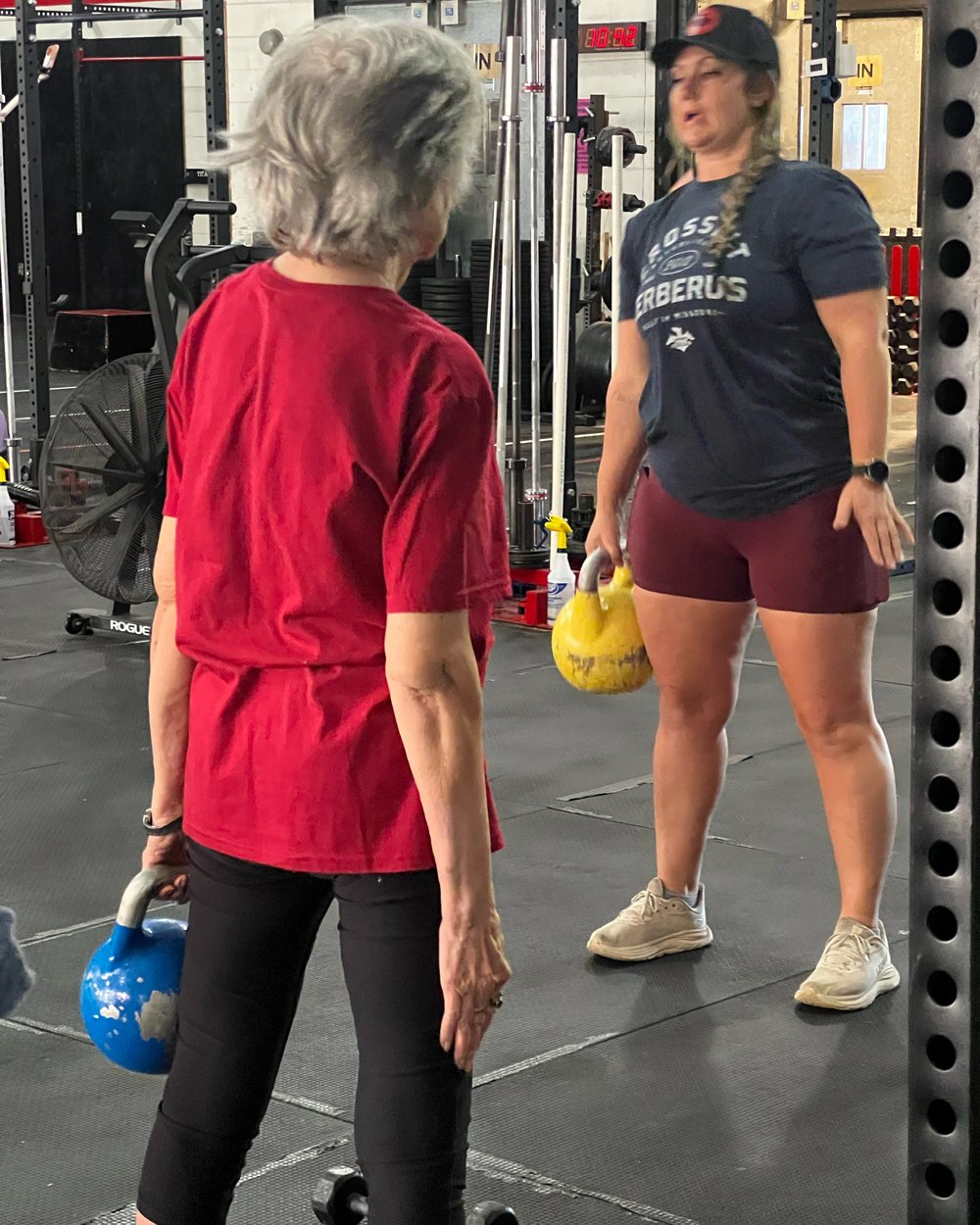
In your free class, the coach watches you lift, then chooses a bell that fits your strength, joints, and goals. Every movement is customized to you, and the bell can change by lift: one weight for the jerk, another for the snatch. Sets start at a few minutes and build from there, with progress tested every 10 weeks so bell changes are based on what you actually did.
Carl has coached since 1994 and brings a background in gymnastics, massage, and corrective exercise to how he fits a bell to a lifter. Lifters train from age 13 up, including adults in their 60s, and people from Blue Springs, Lee's Summit, Independence, Grain Valley, and Oak Grove train side by side. If you are new to kettlebells and over 40, Kettlebell Sport After 40 covers what to expect.
Book a free kettlebell class on the Kettlebell Sport page.