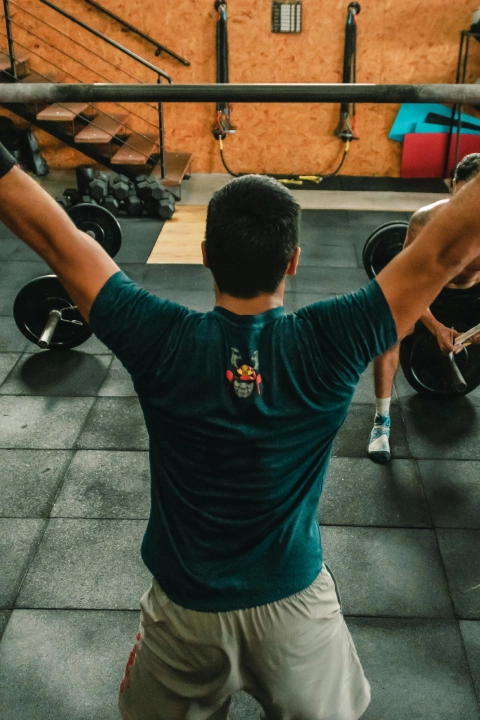
The bench press for beginners comes down to four things: a tight setup, a grip that keeps the forearms vertical, a controlled touch on the lower chest, and a load you can move for clean reps. Start with the empty bar or light dumbbells, train it two times per week, and add small amounts of weight only when every rep looks the same. At CrossFit Cerberus in Blue Springs, a coach checks each of those points in every class.
The bench press is one of the 5 main lifts we teach, along with the squat, shoulder press, bent over row, and deadlift. Below is how the lift works, what the coach watches for, how the Cerberus process borrows from Westside Barbell, and why the bench matters for adults over 40 and for athletes.
How to Bench Press: The Setup for Beginners
Most missed reps and sore shoulders start before the bar moves. The setup has five steps.
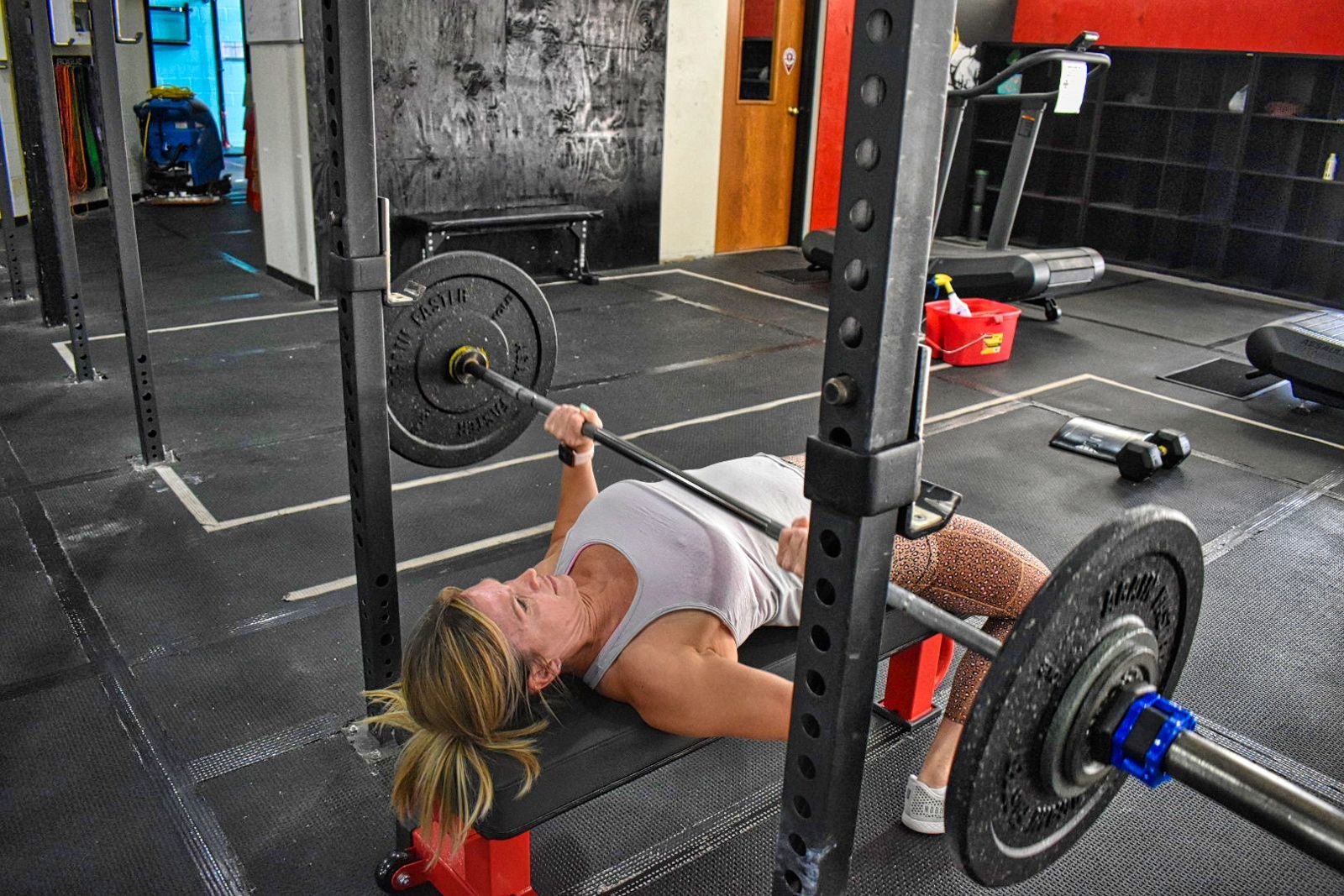
- Eyes under the bar. Lie down so your eyes are directly under the bar in the rack.
- Grip. Hands slightly wider than shoulder width, so the forearms are vertical when the bar touches your chest. Wrap the thumbs around the bar. The bar sits low in the palm, over the wrist, not back toward the fingers.
- Shoulder blades. Pull them back and down into the bench. This gives you a stable base and puts the shoulder in a safer position.
- Feet. Flat on the floor, under or slightly behind the knees. Push through them lightly. The hips stay on the bench the whole set.
- Unrack. Take a breath, press the bar off the hooks, and bring it over the shoulders with locked elbows before the first rep.
The Rep
Lower the bar under control to the lower chest, around the bottom of the breastbone. The elbows sit about 45 to 70 degrees from the torso, not straight out to the sides. Touch the chest without bouncing, then press up and slightly back so the bar finishes over the shoulders. Breathe in at the top, hold it on the way down and up, and breathe out at the top.
What the Coach Checks
- Elbows flaring wide at the bottom. This shifts stress to the front of the shoulder.
- Butt coming off the bench. It means the weight is too heavy or the feet are too far forward.
- Bar bouncing off the chest. Bouncing hides a weak bottom position and bruises the sternum.
Bench Press for Beginners in Blue Springs: Sets, Reps, and Progress
A beginner does not need a complicated program. Here is a common starting point in a Cerberus class:
- Weeks 1 to 2: 3 sets of 8 with the empty bar, dumbbells, or a light training bar. Rest 90 seconds. The goal is the same setup every set.
- Weeks 3 to 6: 4 sets of 6. Add 5 pounds total to the bar when all sets look clean, or move up one dumbbell size.
- After week 6: 5 sets of 5, or a heavier set of 3 followed by back off sets of 6, depending on the class level that day.
Every workout is written in levels 1 to 5, and the coach customizes the movement to the person. A level 1 option might be a dumbbell floor press, which limits the range of motion and takes the bottom position off the shoulder. A level 5 option might be a close grip bench press against bands. Same lift, different version, matched to what you can do well today.
If you train in Blue Springs, Lee's Summit, Independence, Grain Valley, or Oak Grove and have never touched a barbell, our post on starting CrossFit over 40 covers what the first weeks look like.
How the Cerberus Bench Press Is Inspired by Westside Barbell
Westside Barbell in Columbus, Ohio, founded by Louie Simmons, built the conjugate method. The Cerberus lifting process is inspired by it. We are not affiliated with Westside. We use three of its ideas, customized for group classes and beginners.
Rotate the Variation
Westside trains a different max effort bench variation each week and rotates through them. Its standard bench variations article lists the close grip bench press among those variations and says each exercise comes up about once per month. The reason is mechanical: a new variation changes where the lift is hard, so you keep building strength without grinding the same pattern into the ground. At Cerberus the bench shows up as medium grip, narrow grip, wide grip, board press, pin press, or bands and chains, depending on the week and the person.
Train the Weak Range
Westside uses partial range presses to target one part of the lift. In its basic press variations article, the pin press set with the arms at 90 degrees shifts the work from off the chest to near lockout, and the floor press puts heavy focus on the triceps and upper back. A lifter who misses at lockout gets a different variation than one who stalls off the chest.
Build the Muscles Around the Lift
Westside programs back the bench with triceps work and upper back work like rows and lat pulldowns. A strong upper back holds the shoulder blades in place on the bench. This is one reason the bent over row is also one of our 5 main lifts.
What We Change for Beginners
Westside's own speed bench guide says it does not typically recommend dynamic effort training to beginners. We agree. New lifters at Cerberus spend their first months on the regular bench and close grip bench with moderate weight. Bands, chains, and max effort singles come later, once the setup holds under load. Every member gets a personal strength path that starts by getting them out of pain and builds toward their strength goal.
Why the Bench Press Matters for Adults Over 40
Pushing strength is what gets you up off the floor, pushes a heavy door, and catches you with your arms if you fall forward. The bench press trains the chest, shoulders, and triceps through that same pushing pattern, with a load you can measure and add to.
The CDC recommends that adults 65 and older do muscle strengthening activities at least 2 days per week that work all major muscle groups, including the chest, shoulders, and arms, along with aerobic and balance work. See the CDC guidelines for older adults. Two bench sessions a week inside a full program covers the pushing part of that.
For adults over 40, the bench press is customized in a few ways:
- Dumbbells first if the shoulders feel uneven. Each arm works on its own and finds its own path.
- Floor press or board press if the bottom of the lift bothers the shoulder. The shorter range lets you load the top of the lift.
- More warm up sets and longer rest, 2 to 3 minutes between working sets.
- Reps in the 5 to 10 range most weeks, rather than heavy singles.
Our Strong and Steady 60+ program uses the same approach for adults 60 and up, and the Start Here Workshop teaches the 5 main lifts to beginners before they join regular classes.
Why Athletes Need a Bench Press Foundation
Speed and power come from producing force fast. You cannot produce force fast that you cannot produce at all, so base strength sets the ceiling. The bench press builds that base for every pushing and pressing movement.
- CrossFit athletes: push ups, handstand push ups, and dips all draw on the same chest, shoulder, and triceps strength. A stronger bench makes high rep push ups feel lighter.
- Kettlebell sport athletes: the press and lockout positions depend on triceps strength and a stable shoulder.
- Field and court athletes: football linemen, wrestlers, and basketball players push opponents.
Bench Press FAQ
How much should a beginner bench press?
Start with a weight you can press for 8 clean reps with two reps left in reserve. For many people that is the empty barbell, and for some it is a pair of dumbbells or a lighter training bar. Strength charts by bodyweight are not a useful target in month one. Clean reps and steady weekly jumps are the target.
How often should a beginner bench press?
Two times per week is enough for most beginners. That gives the chest, shoulders, and triceps 48 to 72 hours between sessions, and it gives you enough practice to learn the setup. At Cerberus the bench rotates with the other main lifts, so you press, squat, row, and deadlift across the week.
Should you arch your back when you bench press?
A small arch is normal. It comes from pulling the shoulder blades back and down and keeping the upper back tight on the bench. The hips stay on the bench and the feet stay on the floor. A large competition arch shortens the range of motion and is not needed for a beginner learning the lift.
Is the bench press safe for people over 50?
Yes for most people, when the load is right and the setup is correct. The common shoulder complaint comes from elbows flared wide and the bar touching too high on the chest. Tucking the elbows and touching lower fixes most of it. If you have a shoulder injury, get cleared by a doctor or physical therapist first.
Do I need a spotter to bench press?
Use a spotter or safety pins any time you are working near your limit. In a coached class, a coach or partner spots heavy sets, and the rack pins are set just below chest height so a missed rep rests on the pins. Never bench heavy alone with no pins and collars on the bar.
How CrossFit Cerberus Coaches the Bench Press in Blue Springs
Every class at CrossFit Cerberus is coached. You get a coach watching your setup, your touch point, and your elbows on every working set, and a version of the bench press customized to your shoulders and your level. Carl Neidholdt has coached since 1994 and holds CrossFit Level 2, with a background in corrective exercise. The coaching culture is "perfect the basics" at every level, so a beginner and an experienced lifter both get corrected on the same five points.
What you get from week to week: a written plan for the lift, a variation picked for where you are weak, and small load increases you can track. The gym is at 200 NW 11th St in Blue Springs, a short drive from Lee's Summit, Independence, Grain Valley, Oak Grove, and eastern Kansas City.
Book a free trial class on the CrossFit Classes page.